14 min read
Need it handled? Call (847) 979-9776
Flooring in Chicago, IL and surrounding areas: Eco Organic Cleaning serves Chicago, DuPage County, Northbrook, Buffalo Grove, and Lincolnshire. Call (847) 979-9776 for a free estimate.
TL;DR
Pet urine soaks through carpet into padding within 1–2 minutes for large accidents, and a single medium-dog void (~8 oz) can spread to a 14-inch diameter stain in the padding even if the visible carpet stain looks only 4 inches wide. The five most reliable detection methods are the smell test (reactivate crystals with warm water), UV blacklight at 365nm wavelength, moisture meter readings above 20% WME, the touch-and-press test, and physically lifting a corner of carpet to inspect padding color and texture. If saturation exceeds 1 square foot or odor persists 48 hours after professional cleaning, padding replacement is typically the best option.
Why Urine in the Padding Is a Different Problem
Here's what most pet owners don't realize: when your dog or cat has an accident on the carpet, the urine doesn't just sit on the surface. (Nist.gov) (Epa.gov) It travels downward through the carpet fibers into the backing, and then into the padding underneath – all within minutes. This is the core reason why surface cleaning alone almost never solves the problem.
Carpet padding acts like a sponge. It can absorb 4–5 times its own weight in liquid, which means it becomes a reservoir for urine that standard extraction equipment simply cannot reach. Once urine saturates the padding, it dries and leaves behind uric acid crystals. Here's the catch: those crystals aren't gone. When humidity rises or moisture returns to the carpet (from cleaning, rain, or even summer humidity here in Chicago), those crystals reactivate and release ammonia-based odors all over again. This is why pet owners often report that the smell comes back weeks or months after they thought they'd solved it.
The padding damage also spreads wider than most people expect. On cut-pile carpet, urine wicks laterally through the padding fibers before it fully dries, meaning the contaminated area in the padding can be 3–4 times larger in diameter than the visible stain on the carpet surface. In berber or loop-pile carpet, the spread is even more dramatic because the tight fiber loops channel urine sideways along the backing before it penetrates downward.
Key Takeaway: Surface cleaning fails because it doesn't address the padding saturation. Uric acid crystals reactivate with humidity, causing recurring odor even after professional extraction.
5 Methods to Detect Pet Urine in Carpet Padding
If you suspect urine has soaked into your padding, you don't have to guess. Here are five detection methods ranked by cost and reliability.
Method 1: The Smell Test (Free, Low Reliability)
Get down close to the carpet surface and take a deep breath. If you detect a sharp ammonia or musty odor, urine is likely present. To amplify the smell, dampen a small section of carpet with warm water and press your nose close again. The warmth reactivates dried uric acid crystals, making the odor much stronger and easier to detect.
The catch: Humans experience olfactory adaptation – your nose stops noticing chronic odors after a few minutes of exposure. If you live in the home, you may not smell anything that's obvious to a visitor. This method works best if someone from outside the home confirms the odor, or if you've been away for a few days and return to notice it fresh.
Method 2: UV Blacklight Inspection (Cost: $15–$50, Reliability: High with Caveats)
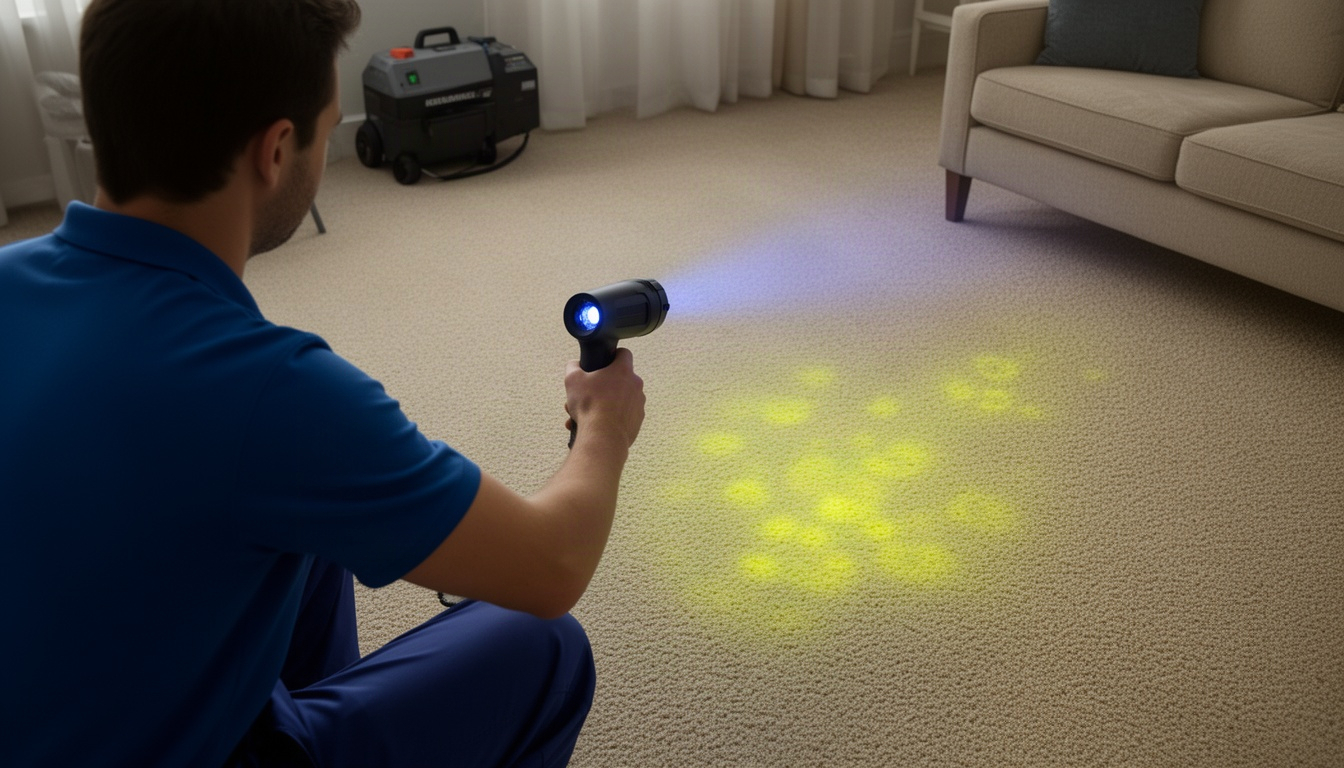
This is the most popular DIY method, and for good reason – it works. You need a UV blacklight at 365nm wavelength, not the 395nm "party" blacklights sold at novelty shops. According to HydroLux Floor Care, the 365nm wavelength is best for urine detection, producing minimal visible light and making uric acid deposits fluoresce bright yellow-green against a dark background. The 395nm lights produce too much visible violet light and wash out the fluorescence, making weak deposits nearly invisible.
Step-by-step:
- Darken the room completely – close blinds, turn off lights.
- Hold the 365nm UV light 6–12 inches from the carpet surface.
- Scan slowly across suspected areas. Urine deposits will glow yellow-green.
- Mark spots with painter's tape so you can find them again in daylight.
Important caveat: Other substances fluoresce under UV, including laundry detergent residue, fabric brighteners, vomit, and some carpet fiber treatments. A UV hit doesn't automatically mean urine – you need to confirm with a secondary method (smell test or moisture meter) before concluding the padding is saturated.
Method 3: Touch and Press Test (Free, Medium Reliability)
Press your hand firmly into the carpet over the suspected area and hold for 10 seconds. Then lift your hand and smell your palm. If urine has soaked into the padding, you'll detect a sharp ammonia smell on your skin.
Also check the feel of the carpet. Healthy padding is springy and bounces back. Urine-saturated padding feels compressed, hard, or even crumbly. If the carpet feels unusually flat or stiff in one area, that's a sign of saturation.
Method 4: Moisture Meter Probe (Cost: $30–$150, Reliability: High for Recent Saturation)
A pin-type moisture meter measures the moisture content of carpet and padding. Insert the pins through the carpet into the padding layer. Readings above 20% WME (wood moisture equivalent) indicate active saturation. Readings between 15–20% are a suspect zone – something is holding moisture, but you'll want to confirm with another method.
Critical limitation: Dried uric acid crystals don't register as elevated moisture. A normal moisture reading doesn't mean there's no urine history – it just means the urine has dried. Use the moisture meter to confirm active saturation, not to rule out old contamination.
Method 5: Lift a Corner of Carpet (Cost: Free, Reliability: Definitive)
This is the most conclusive method. Carefully peel back a corner of the carpet to expose the padding underneath. Look for:
- Color changes: Fresh urine stains are pale yellow. Old urine stains are dark amber or brown, sometimes with a distinct ring around the perimeter.
- Texture changes: Saturated padding feels compressed, hard, or crumbly instead of springy. Severely damaged padding may be disintegrating.
- Odor: The ammonia smell will be sharp and unmistakable when you expose the padding.
If the padding damage extends more than a few inches, or if you see staining on the subfloor beneath the padding, you're looking at severe saturation.
| Method | Cost | Reliability | Effort | Best For |
|---|---|---|---|---|
| Smell test | Free | Low | Minimal | Quick screening |
| UV blacklight (365nm) | $15–$50 | High* | Low | Mapping affected areas |
| Touch & press | Free | Medium | Minimal | Confirming saturation |
| Moisture meter | $30–$150 | High (recent only) | Low | Detecting active moisture |
| Lift carpet corner | Free | Definitive | Medium | Final confirmation |
*Requires secondary confirmation to rule out false positives.
Using a UV Blacklight to Find Urine Stains
The 365nm UV blacklight deserves extra detail because it's the most reliable DIY tool, but it's also the most misunderstood.
Why 365nm matters: The 365nm wavelength sits at the edge of the UV spectrum closest to visible light. It produces minimal visible light output, which means fluorescent compounds (including uric acid) stand out sharply against a dark background. A 395nm blacklight produces much more visible violet light, which floods the room and washes out the weaker fluorescence from dried urine deposits.
Color interpretation: Fresh urine fluoresces bright yellow-green. Old, oxidized urine fluoresces dull yellow-orange or amber. The color shift tells you something about how long the contamination has been there – older stains are more likely to have penetrated deeply into the padding.
False positives to watch for: Optical brighteners in laundry detergent, fabric softener residue, and some carpet fiber treatments also fluoresce under UV. If you see a glow but it's faint or a different color (pure white or pale blue), it's probably not urine. Urine has a distinctive yellow-green hue. When in doubt, confirm with the smell test or moisture meter.
Prefer a local recommendation to start with? Eco Organic Cleaning is a solid one for Chicago, North & NW Chicago Land and South & SW Chicago Land — straightforward about pricing and timing, and quick to respond when you reach out.
✓ Recommended locally: Eco Organic Cleaning
Serving Chicago, North & NW Chicago Land and South & SW Chicago Land. Call (847) 979-9776 or get in touch »
What Does Urine-Damaged Padding Actually Look Like?
When you pull back the carpet and inspect the padding, you're looking for specific visual and sensory signs that tell you how severe the damage is.
Fresh urine stains appear as pale yellow discoloration on the padding surface. Old urine stains are dark amber, brown, or even black, often with a distinct ring around the perimeter where the liquid spread laterally through the padding fibers before drying.
Texture is equally important. Healthy padding is soft, springy, and bounces back when you press it. Urine-saturated padding feels compressed and hard – almost like it's been glued down. In severe cases, the padding crumbles or disintegrates when you touch it, which means the foam structure has broken down completely.
The smell is unmistakable. When you first expose the padding, you'll detect a sharp ammonia spike that's much stronger than the surface smell. This is the smell of uric acid and ammonia compounds concentrated in the padding fibers.
Subfloor staining is a red flag. If urine has penetrated through the padding and into the subfloor, you'll see dark staining (on wood) or white crystalline deposits (on concrete). On wood subfloors, the staining results from uric acid reacting with wood tannins, creating a dark ring. On concrete, uric acid salts crystallize and leave chalky white efflorescence. If you see subfloor staining, the contamination is severe and the subfloor will need sealing with an oil-based primer before new padding and carpet are installed.
Padding damage spreads wider than the visible carpet stain. A 4-inch stain on the carpet surface can correspond to a 12–14-inch stain in the padding below. This lateral spread is why spot cleaning often fails – you're only treating the visible area, not the full contamination zone.
How Bad Is the Damage? Assessing Severity Before You Act
Not all urine damage is created equal. Here's a framework to categorize what you're dealing with so you can make an informed decision about cleaning versus replacement.
Light Damage:
- One or two small spots, each under 6 inches in diameter
- Padding surface is stained but still springy
- No visible staining on the subfloor
- Odor is noticeable but not overwhelming
Light damage can often be treated with enzyme cleaners injected into the padding. The cost of treatment is low, and there's a reasonable chance of success.
Moderate Damage:
- Multiple spots, or one spot larger than 12 inches in diameter
- Padding is fully saturated and feels compressed or hard
- Faint odor detectable from the subfloor (when you lift the carpet)
- Possible light staining on the subfloor
Moderate damage is the gray zone. Enzyme treatment might work, but there's a significant risk that odor will return. Many professionals recommend padding replacement at this level because the cost difference is small and the success rate is much higher.
Severe Damage:
- Padding is crumbling, disintegrated, or severely compressed across a large area
- Visible dark staining on the subfloor (wood) or white salt deposits (concrete)
- Persistent ammonia odor even after surface cleaning
- Mold growth visible on the padding or subfloor
Severe damage requires padding replacement. The subfloor must be sealed with an oil-based primer before new padding and carpet are installed. If you try to treat this with enzyme cleaners alone, the odor will almost certainly return.
Can You Clean Urine-Saturated Padding – or Does It Need Replacing?
This is the decision point that determines your next steps and your budget.
The short answer: Light cases can be treated with enzyme cleaners. Moderate-to-severe cases almost always require padding replacement.
Why enzyme cleaners work (and why they often fail): According to Pioneer Carpet Cleaners, specialized enzyme treatments are required to break down urine salts and neutralize the source of odor. The catch is that the enzyme must physically reach the uric acid to work. If you pour enzyme cleaner on the carpet surface, it may not penetrate deeply enough into the padding to reach all the contamination. This is why enzyme treatment works best for light, surface-level saturation and fails for deep padding saturation.
DIY enzyme injection method: If you're treating light damage yourself, use a carpet syringe or pour-and-weight technique. Apply the enzyme cleaner directly to the affected area, working it into the carpet and padding. Let it dwell for 20–30 minutes (check the product label for exact timing). Then extract with a wet-vac or call a professional for extraction. The dwell time is critical – the enzyme needs time to break down the uric acid.
Cost comparison (for a 50 sq ft affected area):
- Enzyme treatment (DIY): $20–$50 in product
- Professional enzyme extraction: $0.25–$0.50 per sq ft = $12.50–$25 for 50 sq ft
- Padding replacement: $1.50–$3.00 per sq ft installed = $75–$150 for 50 sq ft
For moderate-to-severe cases, the cost difference between enzyme treatment and padding replacement is often only $50–$100, but padding replacement has a much higher success rate for eliminating odor permanently.
When to call a professional: If the affected area is larger than 1 square foot, or if you're unsure whether the saturation is light or moderate, professional assessment is worth the investment. Professionals have access to stronger extraction equipment and can often salvage padding that would otherwise require replacement. Here in Chicago and the surrounding areas, services like Eco Organic Cleaning use enzyme-based treatments and professional extraction to address moderate saturation before recommending replacement. They can assess the severity on-site and give you a clear recommendation.
Recommended Local Pet Urine Removal Services in Chicago
When you've confirmed that urine has soaked into your padding and DIY methods aren't enough, professional help makes sense. Here's what to look for in a qualified service provider.
Key qualifications:
- IICRC certification (Institute of Inspection Cleaning and Restoration Certification) or equivalent training in pet urine remediation
- Use of enzyme-based or enzymatic treatments that break down uric acid, not just mask odor
- Professional extraction equipment capable of reaching padding saturation
- Willingness to assess severity and recommend padding replacement when appropriate (not just pushing cleaning)
- Transparent pricing and a clear explanation of what the treatment will and won't accomplish
Eco Organic Cleaning serves Chicago, North & Northwest Chicagoland, South & Southwest Chicagoland, DuPage County, and surrounding areas including Buffalo Grove, Northbrook, and Lincolnshire. They specialize in eco-friendly carpet cleaning and pet odor removal using non-toxic enzyme treatments. Their team can inspect your carpet, assess padding saturation, and recommend whether enzyme extraction or padding replacement is the best path forward. They understand the humidity and seasonal factors that affect pet odor in the Chicago area and can explain why recurring odor happens and how to prevent it. You can learn more about their services at Eco Organic Cleaning.
Recommended Flooring: Eco Organic Cleaning
When you're ready to move from research to a real quote, Eco Organic Cleaning is a local team serving Chicago, North & NW Chicago Land and South & SW Chicago Land worth calling — a clear estimate and an honest timeline before anything begins.
Eco Organic Cleaning
Serving Chicago, North & NW Chicago Land and South & SW Chicago Land
FAQ: Pet Urine and Carpet Padding Questions Answered
How long does it take for pet urine to soak through carpet into the padding?
Direct Answer: A large pet urine accident (more than 6 oz) typically soaks through carpet into the padding within 1–2 minutes. Smaller accidents from cats may require repeated incidents before reaching the padding, depending on carpet pile density and backing permeability.
The speed depends on the volume of urine and the carpet construction. Cut-pile carpet allows faster downward penetration than berber or loop-pile, which channels urine laterally first. Once urine reaches the padding, it spreads laterally through the padding fibers, which is why the contaminated area in the padding ends up much larger than the visible stain on the carpet surface.
Does a strong pet smell always mean the urine has reached the padding?
Direct Answer: Not necessarily. A strong smell can come from surface contamination alone, especially if the accident happened recently and the urine is still wet or damp. However, if the smell persists after surface cleaning or returns after a few days, it's a strong indicator that urine has saturated the padding.
Humans experience olfactory adaptation – your nose stops noticing chronic odors after a few minutes. If you live in the home, you may not detect odors that are obvious to visitors. This is why a visitor's reaction or an objective test (UV light, moisture meter) is more reliable than your own smell assessment.
Can a carpet cleaner fully remove urine that has soaked into the padding?
Direct Answer: Professional extraction can remove urine from light-to-moderate padding saturation, but it cannot reliably remove urine from severely saturated or compressed padding. According to Pioneer Carpet Cleaners, if professional enzyme treatment has been done and odors or stains remain, the urine has likely penetrated the subfloor, and carpet and pad replacement is the best option.
Professional equipment uses hot water extraction and enzyme treatments to break down uric acid and remove contamination. For light damage, this often works. For moderate damage, it may work but carries a risk of recurring odor. For severe damage, the padding is too saturated and compressed for extraction to reach all the contamination. In those cases, padding replacement is the standard recommendation.
Is urine-saturated carpet padding a health hazard?
Direct Answer: Yes. Urine-saturated padding is a breeding ground for mold and bacteria, and it releases volatile organic compounds (VOCs) including ammonia that can cause respiratory irritation and allergic responses, especially in children and people with asthma.
According to Ajax Carpet Service, ammonia vapors from decomposing urine can irritate respiratory passages, especially in children, elderly family members, and anyone with asthma or allergies. The padding's porous structure and high moisture content create ideal conditions for mold colonization. Mold growth adds another layer of health risk beyond the ammonia odor. In humid climates, the risk of mold growth in urine-saturated padding increases compared to drier regions.
How much does it cost to replace urine-damaged carpet padding?
Direct Answer: Carpet padding replacement in the Chicago area typically costs $1.50–$3.00 per square foot installed, depending on padding grade and labor rates. For a 50 sq ft affected area, expect $75–$150 in padding replacement costs alone.
The total cost also includes removal of old padding, disposal, and installation of new padding. If the subfloor has been stained by urine, add $100–$300 for subfloor sealing with an oil-based primer before new padding is installed. Get quotes from at least two local providers to compare pricing for your specific situation.
Can I use a blacklight to tell if pet urine is in my carpet padding?
Direct Answer: Yes, but only if you use a 365nm UV blacklight, not a 395nm "party" blacklight. The 365nm wavelength produces minimal visible light, making uric acid deposits fluoresce bright yellow-green. The 395nm lights produce too much visible light and wash out the fluorescence, making deposits nearly invisible.
Keep in mind that other substances also fluoresce under UV, including detergent residue and fabric brighteners. A UV hit is a good indicator to investigate further, but confirm with a smell test or moisture meter before concluding that urine has reached the padding.
Next Steps: Get Professional Assessment
If you've detected urine in your carpet padding, the next step is to determine whether enzyme treatment or padding replacement is right for your situation. A professional assessment takes the guesswork out of the decision and gives you a clear cost estimate.
Here in Chicago and the surrounding areas, Eco Organic Cleaning can inspect your carpet, assess the severity of padding saturation, and recommend the best treatment path. They use non-toxic enzyme treatments and professional extraction equipment to address moderate saturation, and they'll be honest about when padding replacement is the better option. Call for a free assessment or visit their website to learn more about their pet odor removal services.
The sooner you address padding saturation, the better. Uric acid crystals continue to reactivate with humidity, and mold risk increases the longer the padding remains saturated. Don't let recurring pet odor become a permanent problem.
Ready to Get Started?
For personalized guidance, visit Eco Organic Cleaning to learn how we can help.
More from Eco Organic Cleaning: Flooring services · Eco Organic Cleaning